Learn it by trying it.
Physics and geography for your next tests. Play with each idea, then check what you remember.
Physics
English
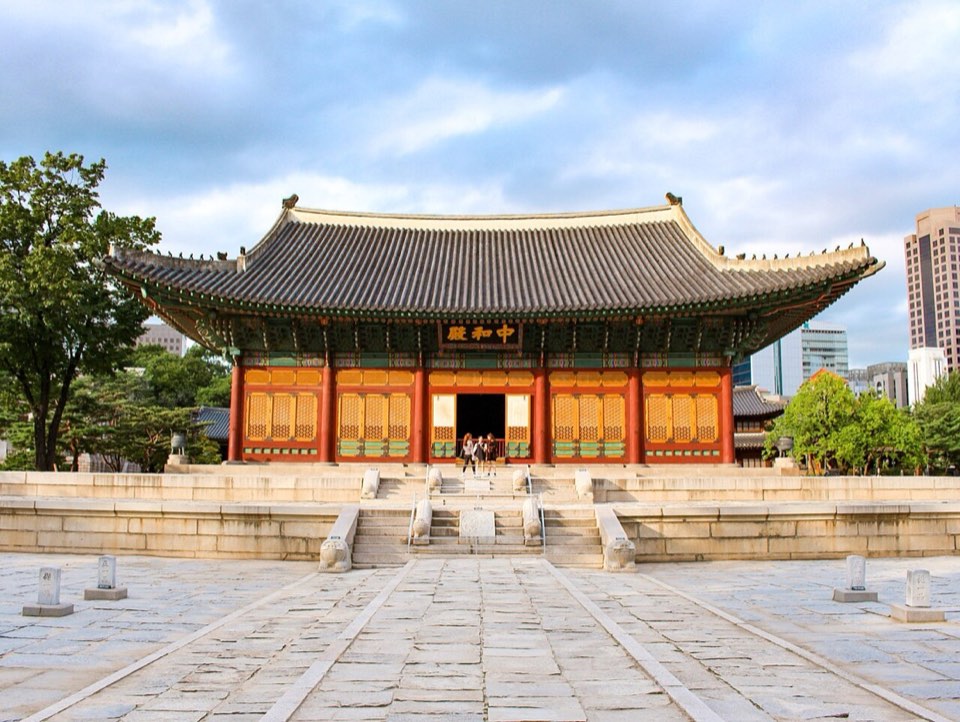
Photos: Stevage, CC BY-SA 2.5 · Suicasmo, CC BY-SA 4.0. Other photos are credited where they appear.
English · 1 of 4
Plural nouns
Most words just add -s. The rest follow a few rules, and some break them all.
Make it plural
Type the plural, then check. You'll see which rule it uses.
The rules
- Add -sMost nouns: cat → cats, pencil → pencils, book → books.
- Add -esNouns ending in -ch, -sh, -s, -x or -o: box → boxes, bus → buses, watch → watches, tomato → tomatoes.
- -y to -iesA consonant plus y: baby → babies, city → cities, country → countries.
- -f to -vesSome -f or -fe nouns: knife → knives, wolf → wolves, shelf → shelves. Exceptions keep -s: roofs, chefs, beliefs, cliffs.
- IrregularThey change completely: man → men, woman → women, foot → feet, mouse → mice, person → people, child → children.
- Spelling changesgoose → geese, ox → oxen, index → indexes or indices, analysis → analyses, phenomenon → phenomena.
- No changeSame in both forms: sheep, fish, series, species.
English · 2 of 4
Active and passive voice
Active says who did it. Passive puts the thing that was done first.
Flip the sentence
Watch the object move to the front.
Three rules
- Object to subjectThe object of the active sentence becomes the subject of the passive sentence.
- Use "be"Use the right form of "be" for the tense: is, are, was, were, has been, will be, is being…
- Past participleAlways use the past participle (V3) of the main verb: written, taken, discovered.
- ModalsModal + be + V3: should be provided, must be sterilized, might have been postponed.
- AdverbsThey can stay put or move somewhere more natural.
- Dependent clausesA clause like "because they studied hard" keeps its place at the start or end.
- Prepositional phrasesThey stay next to what they describe.
Tense by tense
| Tense | Active | Passive |
|---|---|---|
| Simple present | She writes the letter. | The letter is written by her. |
| Present continuous | She is writing the letter. | The letter is being written by her. |
| Present perfect | She has written the letter. | The letter has been written by her. |
| Simple past | She wrote the letter. | The letter was written by her. |
| Past continuous | She was writing the letter. | The letter was being written by her. |
| Past perfect | She had written the letter. | The letter had been written by her. |
| Simple future | She will write the letter. | The letter will be written by her. |
| Future perfect | She will have written the letter. | The letter will have been written by her. |
| Going to | She is going to write the letter. | The letter is going to be written by her. |
| Modal | She should write the letter. | The letter should be written by her. |
| Modal perfect | She might have written the letter. | The letter might have been written by her. |
Worksheet A · active to passive
Say the passive sentence out loud, then open it to check. Keep the tense and any modal.
1. The research team has identified several errors in the experimental results.
Several errors in the experimental results have been identified by the research team.
2. The committee will announce the final list of scholarship recipients tomorrow.
The final list of scholarship recipients will be announced by the committee tomorrow.
3. The engineers were testing the new transportation system when the power suddenly failed.
The new transportation system was being tested by the engineers when the power suddenly failed.
4. The school administration had already informed the parents about the unexpected schedule changes.
The parents had already been informed about the unexpected schedule changes by the school administration.
5. Scientists are investigating the possible effects of climate change on marine ecosystems.
The possible effects of climate change on marine ecosystems are being investigated by scientists.
6. The government should provide additional financial assistance to low-income families.
Additional financial assistance should be provided to low-income families by the government.
7. The principal might have postponed the examination because of the severe weather conditions.
The examination might have been postponed by the principal because of the severe weather conditions.
8. The laboratory technicians must sterilize all the equipment before conducting the experiment.
All the equipment must be sterilized by the laboratory technicians before the experiment is conducted.
9. The investigators will have completed the examination of the evidence by next Friday.
The examination of the evidence will have been completed by the investigators by next Friday.
10. The publishing company is going to release the revised edition of the textbook next month.
The revised edition of the textbook is going to be released by the publishing company next month.
Worksheet B · passive to active
Find who did the action and put them first.
11. The historical documents are carefully examined by the researchers before they are displayed in the museum.
The researchers carefully examine the historical documents before displaying them in the museum.
12. The missing files were discovered by the IT department during the system inspection.
The IT department discovered the missing files during the system inspection.
13. The new educational policies are being reviewed by the school board this week.
The school board is reviewing the new educational policies this week.
14. The final decision has been communicated to all department heads by the director.
The director has communicated the final decision to all department heads.
15. The ancient temple had been restored by a team of skilled architects before the tourists arrived.
A team of skilled architects had restored the ancient temple before the tourists arrived.
16. The students will be evaluated according to their performance by the examination committee.
The examination committee will evaluate the students according to their performance.
17. The confidential information must not be shared with unauthorized individuals by the employees.
The employees must not share confidential information with unauthorized individuals.
18. The damaged equipment should have been replaced by the maintenance team before the experiment began.
The maintenance team should have replaced the damaged equipment before the experiment began.
19. The research findings may have been misinterpreted by several journalists.
Several journalists may have misinterpreted the research findings.
20. The new bridge will have been completed by the construction company before the rainy season begins.
The construction company will have completed the new bridge before the rainy season begins.
21. The invitations are going to be distributed by the student council after the meeting.
The student council is going to distribute the invitations after the meeting.
22. The suspect was being questioned by the investigators when his lawyer arrived.
The investigators were questioning the suspect when his lawyer arrived.
23. The environmental regulations have been violated by several manufacturing companies.
Several manufacturing companies have violated the environmental regulations.
24. The missing evidence could have been overlooked by the investigators during the initial examination.
The investigators could have overlooked the missing evidence during the initial examination.
25. The final proposal would have been approved by the board of directors if the financial report had been submitted on time.
The board of directors would have approved the final proposal if the financial report had been submitted on time.
English · 3 of 4
Paraphrasing and summarizing
A paraphrase says the same thing in new words. A summary says only the main idea, much shorter.
Pick the best one
Read the original, then choose.
Tips for a good summary
- Key ideasKeep the main points. Drop details and examples.
- Your own wordsDon't copy sentences.
- No opinionsSay what the text says, not what you think.
- Present tense"The author explains…", not "explained".
Examples from class
The dog ran quickly through the park, wagging its tail happily.
The dog sped through the park, its tail wagging with joy.
Her smile was a ray of sunshine, brightening the whole room.
Her smile lit up the room like a beam of sunlight.
He felt like a fish out of water in the crowded room.
He felt uncomfortable and out of place in the busy room.
“In the middle of difficulty lies opportunity.”
Every challenge carries the possibility of a new opportunity.
English · 4 of 4
Spelling
Listen, then type the word.
The words
Everything
Everything
Every card in one place.
Practice
Test plan
Add your test dates. You'll get a day-by-day plan for the topics you haven't finished.
Physics · 1 of 6
Everything is made of tiny particles.
They move all the time, have gaps between them and pull on each other. How hard they pull decides if something is a solid, a liquid or a gas.
States of matter
Choose a state, then change the temperature.
Particles are held in fixed positions by strong attractions. They can only vibrate, so a solid keeps its shape and volume.
The four ideas
- ParticlesAtoms or molecules. A molecule is two or more atoms bonded together.
- SpaceGases have big gaps between particles. Solids have almost none.
- MotionParticles never stop moving. Heat makes them faster.
- AttractionParticles pull on each other. That's why water curves up the sides of a glass.
Diffusion in water
Tap the beaker to add a drop of food colouring.
No one stirs the water. Its particles are always moving, so they keep colliding with the dye until it spreads evenly. This spreading is called diffusion.
Explain the class demos
Why does sugar dissolved in water take up less space than expected?
Water molecules have small spaces between them. Sugar molecules fit into those spaces instead of pushing the water outward. Sugar also forms hydrogen bonds with water, which pulls the particles slightly closer.
Why can air in a syringe be compressed but water cannot?
Gas particles are far apart, so the plunger moves in easily and springs back. Liquid particles are already touching, so there is no space left to squeeze them into.
Why can you smell perfume across a room within seconds?
The perfume's gas particles move randomly in every direction and mix with the air. This is diffusion.
Why does a table, a rock or a coin keep its shape?
Its particles are held in fixed positions by strong attractions. They can only vibrate in place.
Physics · 2 of 6
Density
How tightly packed something is. It decides what floats.
Buoyancy test
Drop a material into water and compare its density with water's.
- MassHow much matter something has.
- VolumeHow much space it takes up. Box: l × w × h.
- StatesSolid › liquid › gas, from most to least dense.
- TemperatureHeat lowers density. Solid gold 19.32 g/cm³, melted gold 17.19 g/cm³.
- WaterIce is less dense than water. That's why ice floats.
Density calculator
Enter any two values to find the third.
Practice problems
1. Granite has a mass of 15.5 g and a volume of 6.01 cm³. Find its density.
ρ = 15.5 ÷ 6.01
≈ 2.58 g/cm³
2. Gold is 19.3 g/cm³. Find the mass of a 44.9 cm³ bar.
m = ρ × V = 19.3 × 44.9
≈ 866.6 g
3. A 5 cm cube is filled with 100 g of liquid. Find the liquid's density.
V = 5 × 5 × 5 = 125 cm³
ρ = 100 ÷ 125
0.8 g/cm³
4. Isopropyl alcohol is 0.785 g/cm³. Find the volume of 50 g.
V = m ÷ ρ = 50 ÷ 0.785
≈ 63.7 cm³
5. A piece of wood has a mass of 96.4 g. Find its density.
Multiply the three measurements shown in the slide's diagram to find V, then calculate 96.4 ÷ V. The measurements are only in the diagram, so check the slide.
6. A 9 cm cube has a mass of 3,645 g. Find its density.
V = 9 × 9 × 9 = 729 cm³
ρ = 3645 ÷ 729
5 g/cm³
7. A block measures 5 m × 2 m × 4 m and has a mass of 300 g. Find its density.
V = 5 × 2 × 4 = 40 m³
ρ = 300 ÷ 40
7.5 g/m³
Note the units: the block is measured in metres, not centimetres.
Physics · 3 of 6
A force is a push or a pull.
Measured in newtons (N) with a spring balance.
Five effects of a force
Choose an effect, then apply the force.
A force can make a still object move. An ice hockey player strikes a puck at rest.
Contact and non-contact forces
Formative test
What is a force? Give three examples.
A push or pull in a particular direction, resulting from one object interacting with another. Examples: kicking a ball, friction slowing a sliding book, gravity pulling an apple to the ground.
What is the SI unit of force, and what instrument measures it?
The newton (N), measured with a spring balance
Identify the effect: making a clay pot from mud.
It changes the shape of the material.
Identify the effect: pushing a cart.
It makes the cart move, or speeds it up.
Identify the effect: kicking a rolling ball sideways.
It changes the ball's direction.
Identify the effect: bending a bamboo stick.
It changes the stick's shape.
Identify the effect: a strong typhoon blowing over a field.
It moves objects and changes their shape.
Plants bend and loose objects are carried away.
Why does a cup fall down rather than float up?
Gravity, a non-contact force, pulls it toward the centre of the Earth.
Physics · 4 of 6
Newton's three laws of motion.
Why things stay still, why they speed up, and why every push pushes back.
Net force
Set the two forces. Equal and opposite forces are balanced.
First law: inertia
An object at rest stays at rest, and a moving object keeps moving in a straight line, unless an unbalanced force acts on it.
The coin and card
Remove the card quickly or slowly and watch the coin.
Flick the card away fast. Where does the coin go?
- A bus pulls awayYour body stays put, so you feel pushed back.
- A bus brakesYour body keeps going, so you lurch forward.
- A sharp turnYour body wants to go straight, so you slide outward.
Second law: acceleration
- Force increasesMore force, more acceleration.
- Mass increasesMore mass, less acceleration.
- GravityFalling things speed up by 9.8 m/s every second. g = 9.8 m/s².
F = ma calculator
Enter any two values to find the third.
A 0.60 kg ball is hit with a force of 12 N. Find its acceleration.
a = F ÷ m = 12 ÷ 0.6
20 m/s²
The force on the same ball increases to 24 N. Find the new acceleration.
a = 24 ÷ 0.6
40 m/s²
Doubling the force doubles the acceleration.
A falling rock produces a force of 147 N. Find its mass.
m = F ÷ g = 147 ÷ 9.8
15 kg
Third law: interaction
For every action there is an equal and opposite reaction. Forces always come in pairs that act on two different objects.
- A rocketIt pushes gas down. The gas pushes it up.
Physics · 5 of 6
Pressure
More area, less pressure.
Pressure on snow
The same 600 N person, three different shoes.
- SnowshoesBig area, low pressure. You stay on top.
- A knife edgeTiny area, huge pressure. It cuts.
- PortersA cloth pad spreads the load, so it presses less.
Pressure calculator
Enter any two values to find the third.
Practice problems
1. A 520 N woman stands on a man's foot with one heel of area 0.001 m².
P = 520 ÷ 0.001
520,000 Pa
2. A 24,000 N elephant stands on one foot of area 0.4 m².
P = 24,000 ÷ 0.4
60,000 Pa
The heel exerts almost nine times the pressure of the elephant's foot.
3. The contact area is 3 m² and the pressure is 15 N/m². Find the force.
F = P × A = 15 × 3
45 N
4. A box exerts 240 N at a pressure of 80 N/m². Find the contact area.
A = F ÷ P = 240 ÷ 80
3 m²
5. The contact area is 1.8 m² and the pressure is 60 N/m². Find the force.
F = 60 × 1.8
108 N
Physics · 6 of 6
Energy never disappears.
It only changes form. The total stays the same.
- WorkOnly counts when the force moves something.
- Potential energyEnergy stored because of height. PE = m × g × h
- Kinetic energyEnergy of motion. KE = ½ × m × v²
- Mechanical energyME = PE + KE. Without friction it is the same at every point.
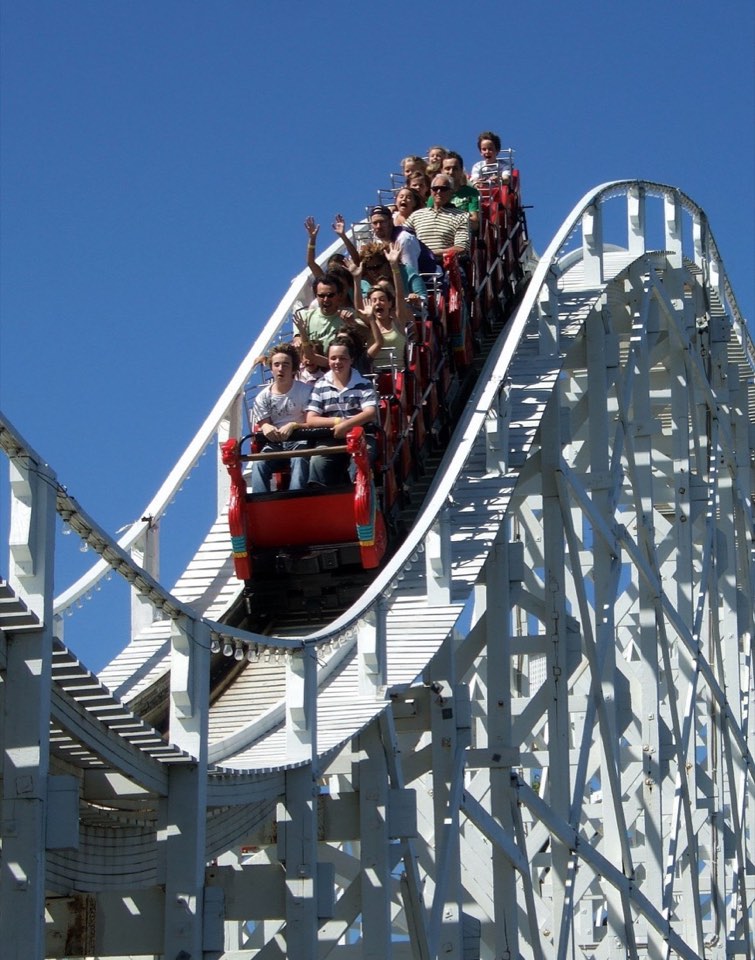
Energy on a roller coaster
A 0.5 kg cart starts 20 m up. Assume no friction and g = 9.8 m/s².
More height means ___ PE and ___ KE.
More PE and less KE
As the cart climbs, its velocity ___.
Decreases
Kinetic energy is converted back into potential energy.
At the lowest point, KE is ___ and PE is ___.
KE is at its maximum and PE is zero
The 0.5 kg cart starts at 20 m. How fast is it moving at ground level?
PE = 0.5 × 9.8 × 20 = 98 J
98 = ½ × 0.5 × v², so v² = 392
v ≈ 19.8 m/s
This is a practice example. The values for points A to D are only in the slide's diagram.
A toy car rolls down a ramp. Where does it have the most PE, and is energy lost?
It has the most PE at the top. As it rolls down, PE becomes KE. Energy is not lost: friction converts some of it into heat and sound, which is why the car eventually stops.
Geography · 1 of 4
Mountains, islands and sea.
Japan and the Koreas sit just east of China. Only a narrow strait separates them.
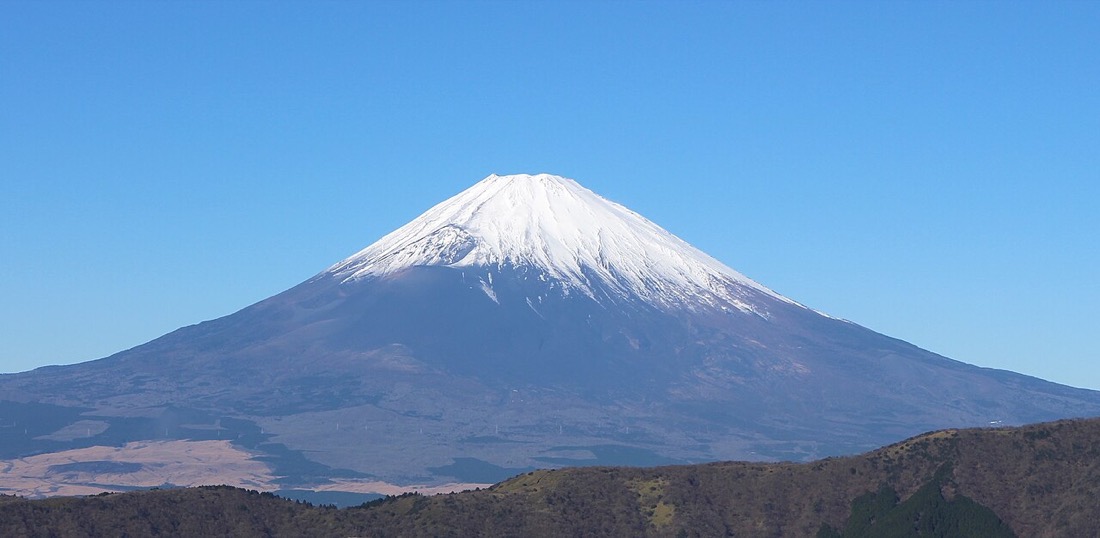
Japan
- An island chain4 large islands and more than 3,000 smaller ones, stretching over 2,400 km (1,500 miles). Its total land area is slightly smaller than California.
- The home islandsFrom north to south: Hokkaido, Honshu, Shikoku and Kyushu. They hold about 95% of Japan's land and most of its people.
- MountainsAbout 75% of Japan is mountains. The largest range, the Japanese Alps, is on Honshu.
- Mount FujiJapan's highest mountain at 3,776 m (12,388 ft). A volcano that is not part of any range, and a sacred symbol of Japan.
The Korean Peninsula
- MountainsLong ranges run along the eastern coast. The highest peaks are in the north.
- PlainsUnlike Japan, Korea has large plains, mainly along the western coast and in river valleys.
- RiversKorea has more rivers than Japan. Most flow west into the Yellow Sea.
Map of Japan and the Koreas
Select a point to learn about it.
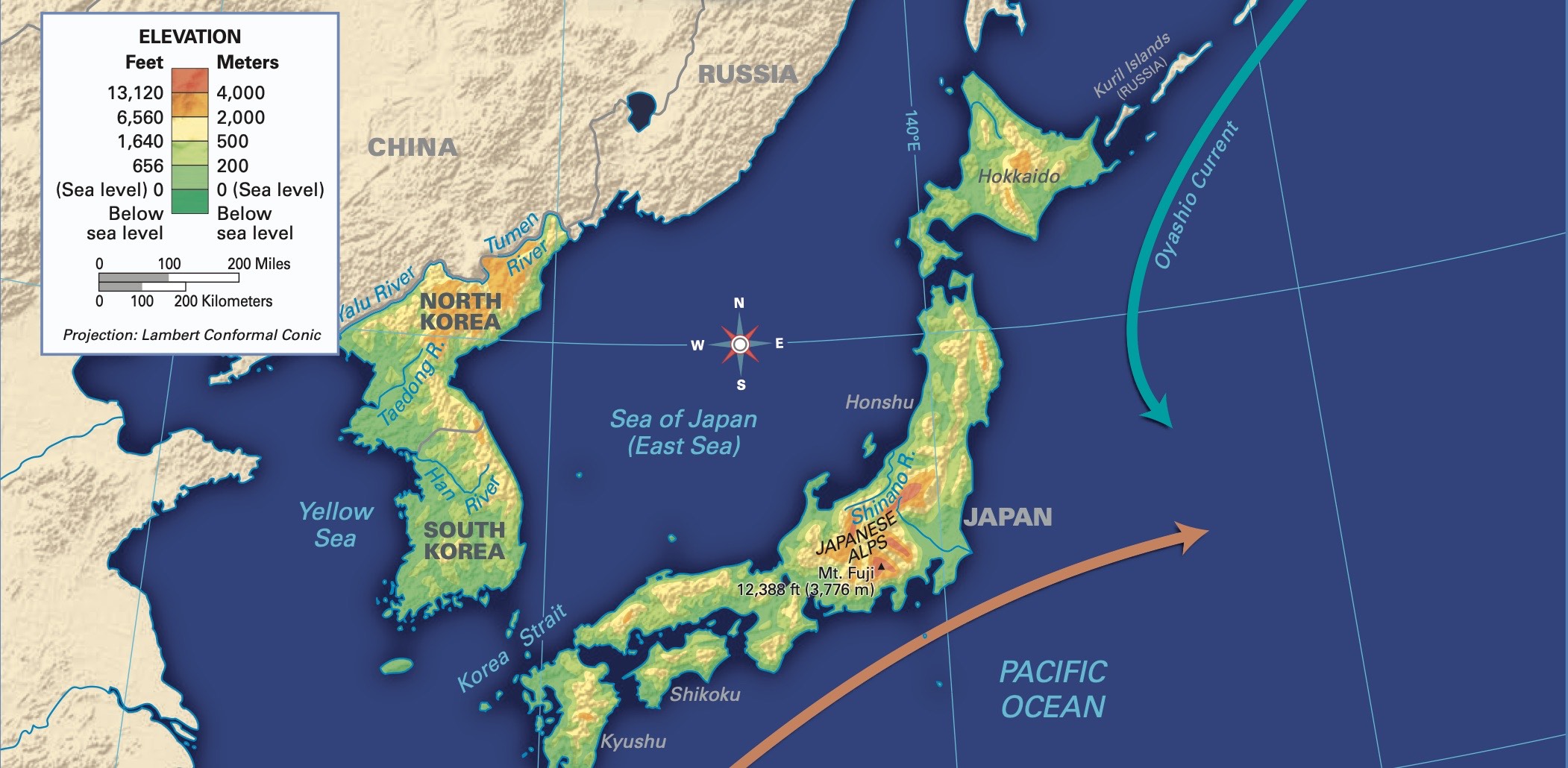
Japan and the Koreas: physical
The map from your textbook, page 952. Mountains show in orange and brown, lowlands in green.
Natural hazards
Compare what each country faces.
Climate and resources
- NorthHumid continental: cool summers, long cold winters and a short growing season.
- SouthHumid subtropical: mild winters, hot humid summers, heavy rain and typhoons. Some places get up to 200 cm (80 in) of rain a year.
- MineralsJapan and South Korea have few. North Korea has large deposits of coal, iron and other minerals.
- HydroelectricityKorea's rocky land and fast rivers make it ideal for producing hydroelectric power.
- FisheriesPlaces full of fish. Ocean currents bring huge numbers to Japan.
Lesson review
What landforms cover Japan and the Koreas?
Mostly rugged mountains. Korea also has plains along its western coast and in river valleys.
How are Japan and Korea's physical features different?
Japan is a chain of islands with volcanoes and frequent earthquakes. Korea is a peninsula with more plains and rivers and few volcanoes or earthquakes.
What climate is found in the north, and what in the south?
North: humid continental. South: humid subtropical.
Why are fisheries important to Japan?
Japan has few mineral resources and little farmland. Its rich fisheries provide food and support one of the world's strongest fishing economies.
On which island are the Japanese Alps?
Honshu
Do more people live in the eastern or western part of Korea? Why?
The western part. The east is covered by mountain ranges, while the west has flat coastal plains and river valleys that are easier to farm and build on.
Geography · 2 of 4
Japan
After wars and disasters, Japan built a democracy and one of the world's biggest economies.
Timeline of Japan and Korea
Select a point, or use the arrow buttons.
History
- The AinuOne of Japan's early cultures. They probably came from Siberia and spoke a language unlike any other in eastern Asia.
- The JomonPeople who lived all over the Japanese islands from 10,500 BC to 300 BC.
- Chinese influenceJapan's first central government was modelled on China's, especially the Tang dynasty (唐). Buddhism began in China and reached Japan by way of Korea.
- EmperorsRuled from the capital at Heian, now Kyoto, a centre of art and learning. Heian was laid out like Chang'an, the Tang capital of China. Over time the emperors' power faded.
- ShogunsPowerful military leaders who ruled in the emperor's name. Only one shogun held power at a time.
- SamuraiHighly trained, fiercely loyal warriors who served the shogun and were greatly respected. A samurai without a master was called a ronin. Shoguns ruled Japan well into the 1800s.
- Opening to the WestIn the 1850s the Perry Expedition from the United States forced Japan to open to trade, and Japan began to Westernize.
- 1868: the Meiji RestorationA group of samurai overthrew the shogun and returned power to the emperor, Emperor Meiji.
- HirohitoEmperor for most of the 1900s, in the Showa era. He led Japan through World War II and the changes after it.
- World War IIJapan joined Germany and Italy as the Axis powers to build an empire in Asia and the Pacific. It bombed Pearl Harbor in 1941 and surrendered in 1945 after atomic bombs hit Hiroshima and Nagasaki.
Culture
- LanguageJapanese uses two kinds of characters. Kanji stand for whole words, with about 2,000 in common use. Kana stand for parts of words, and there are two kinds of kana: hiragana and katakana.
- ReligionMost people blend Shinto and Buddhism. Buddhism came from China by way of Korea. Shinto is native to Japan.
- ShintoBoth polytheistic (many gods) and animistic (gods in everything). It speaks of eight million kami. Worship happens at shrines, marked by a torii gate.
- Main kamiAmaterasu, the sun goddess. Tsukuyomi, the moon god. Susanoo, the storm god.
- Three Sacred TreasuresThe mirror (Kagami), the sword (Tsurugi) and the jewel (Magatama).
- ClothingTraditional clothes include the kimono, the lighter summer yukata and the happi coat worn at festivals. Most of the time, people wear Western-style clothing.
- Performing artsNoh actors wear masks and move little, using music and dance. Kabuki actors are far more active, and the plays often teach lessons about duty. Bunraku is traditional puppet theatre.
Government and economy
- GovernmentA constitutional monarchy. The emperor is a symbol with little power, like the monarch of the United Kingdom. Voters elect a legislature called the Diet, which chooses the prime minister. Tokyo is the seat of government. Citizens can vote from age 18.
- Politics todayThe Liberal Democratic Party (LDP) has been the most powerful party since 1955. Japan now has its first female prime minister.
- ManufacturingJapan's strongest industry, known for high-quality cars and electronics from companies like Sony, Honda and Toyota. Japan has between 40 and 47 of the world's 500 biggest companies.
- Reasons for successGovernment working closely with business, a well-educated workforce, and a strong work ethic: the belief that work is worthwhile in itself.
- Trade surplusJapan exports more than it imports. High tariffs, fees on imported goods, encourage people to buy Japanese products. The United States is its main trading partner.
- Few resourcesJapan must import raw materials and much of its food, because little of its land is arable.
Daily life and challenges
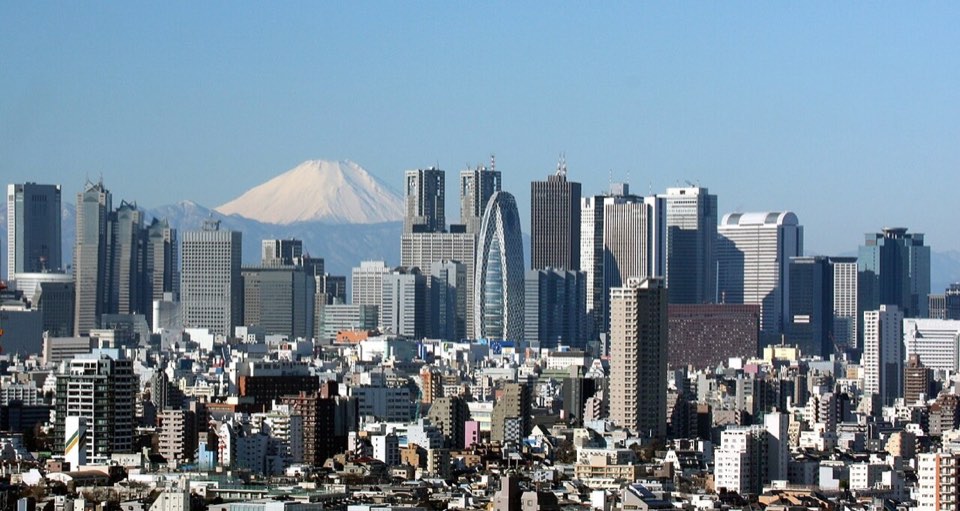
- TokyoThe capital and centre of banking and communication, home to about 13 million people. Land is so scarce that buildings are tall and narrow, shops go underground and capsule hotels save space.
- ShinkansenBullet trains link the cities at more than 260 km/h (160 mph), and almost always run on time.
- ChallengesOvercrowding, competition from China and South Korea, few new businesses and pollution. The Kyoto Protocol (1997) was an agreement to cut pollution.
- 2011An earthquake and tsunami killed more than 18,000 people and caused a meltdown at the Fukushima Daiichi nuclear plant.
Lesson review
Who were the shoguns?
Powerful military generals who ruled Japan in the emperor's name, supported by samurai.
What are the two kinds of kana?
Hiragana and katakana
Name the Three Sacred Treasures.
Mirror (Kagami), sword (Tsurugi) and jewel (Magatama)
What does it mean that Shinto is polytheistic and animistic?
Polytheistic means it has many gods. Animistic means gods, or kami, live in everything in nature.
Why did Japan enter World War II?
It wanted to build an empire in Southeast Asia and the Pacific, and allied with Germany and Italy.
How has Japan's government changed since World War II?
It went from an imperial state cut off from the world to a constitutional monarchy and democracy, where power rests with the people and their elected Diet.
What personal freedoms does Japan's constitution protect?
Equality under the law, the right to pursue happiness, freedom of thought, and the vote for citizens aged 18 and over.
How have people tried to save space in Japan?
Tall, narrow buildings, shops and restaurants underground in subway stations, and capsule hotels.
How are other countries challenging Japan's economy?
Companies in China and South Korea now compete for the same business, taking customers from some Japanese companies.
Geography · 3 of 4
One history, two countries.
North and South Korea share a language and a past. Today they live very differently.
History
- Gojoseon (古朝鮮)The first farming kingdom on the Korean Peninsula. Its best-known trade good was tiger skin. It fell to Han China in 108 BC, and China controlled Korea for a while.
- Three KingdomsGoguryeo (高句麗), Baekje (百濟) and Silla (新羅) competed for control.
- SillaUnified Korea in AD 668. Silla rulers fought China but adopted Chinese Buddhism, writing and government.
- Koryo (Goryeo, 高麗)Ruled from 918 to 1392 and is best known for Goryeo porcelain. The English name Korea comes from Koryo.
- Joseon (朝鮮)Korea's last dynasty, from 1392 to 1897. Its main religion and culture were Buddhism and Confucianism.
- Japanese ruleJapan ruled Korea harshly from 1910 to 1945, and Koreans came to resent it.
- DivisionAfter World War II, Korea was split in two: a Communist North backed by the Soviet Union and a democratic South backed by the United States.
- Korean WarIn 1950 North Korea invaded the South to unite Korea under Communism. The South, helped by the United States and other countries, drove them back. The fighting lasted until 1953. The border today runs roughly along latitude 38° N.
Culture
- LanguageBoth Koreas speak Korean, which is written with an alphabet. Letters combine to form words.
- ReligionTraditional shamanism, Buddhism and Confucianism shaped Korea. Christianity is now the most practised religion in South Korea, though most people don't identify with one. North Korea discourages religion.
- KimchiSpicy pickled cabbage, first made in the 1100s and thought of as Korea's national dish.
Compare the three countries
Switch between them to see how they differ.
South Korea today
- EducationLiteracy rose from about 22% in 1945 to almost 99% today, and South Korean students are among the best performing in the world. Cram schools are a big part of student life. Most people aged 25 to 34 have higher education, but jobs are hard to find, so the government is investing in job training.
- DensitySeoul has more than 17,000 people per km² (44,000 per square mile). Most people live near the coast, especially on the western coastal plain.
- Rural lifeOutside cities, many people farm rice, beans and cabbage for kimchi on small farms.
- CorruptionFour families have long controlled much of the industry. President Park Geun-hye was impeached in 2016 and removed in 2017. Moon Jae-in was elected that May.
- The DMZThe demilitarized zone is an empty buffer zone between North and South Korea. Troops are not allowed in it, but guards patrol both sides.
North Korea today
- GovernmentOfficially the Democratic People's Republic of Korea, but it is neither a democracy nor a republic. It is a totalitarian Communist state.
- LeadersKim Il Sung ruled from 1948 to 1994, his son Kim Jong Il from 1994 to 2011, and his grandson Kim Jong Un rules as a dictator today.
- EconomyA command economy: the government plans what is produced, owns all land and controls jobs. It is rich in minerals but much poorer than Japan and South Korea, because most resources go to the military. Little land is arable, so it must import food.
- Daily lifeMost people live in cities. The capital is Pyongyang. Few people have cars, electricity often runs short, and people have far fewer rights than in Japan or South Korea.
- IsolationThe government's isolationist policies mean it hardly trades, and resources go unused because of poor government choices.
- ThreatsIts leaders have developed long-range missiles and nuclear weapons, threatening stability in the region.
Korean reunification
- Why some want itThe two Koreas share a culture and history, so many people feel they should be one country. Both governments have at times said they are interested.
- The main obstacleSouth Korea wants a reunified Korea to be a democracy. North Korea demands that it be Communist.
Lesson review
Which three kingdoms competed for Korea, and which one won?
Goguryeo, Baekje and Silla. Silla unified Korea in AD 668.
When did Japan rule Korea?
1910 to 1945
Korea was freed when Japan lost World War II, then split into North and South.
Roughly where is the border between North and South Korea?
Along latitude 38° N
The demilitarized zone (DMZ) runs along it.
Why is North Korea poor even though it is rich in minerals?
Most of its resources go to the military, its isolationist government hardly trades, resources go unused because of poor choices, and little land is arable, so it must import food.
What is the main obstacle to Korean reunification?
South Korea wants a democratic government for a reunified Korea. North Korea demands a Communist one.
Geography · 4 of 4
Spotting bias
Bias is favouring one side. It changes how a writer tells a story.
- Look at the words and imagesAre they emotionally charged? Do they show only one side?
- Look at the writerWhat is their background, and what does it suggest about their point of view?
- Look at the sourcesDoes the writer rely only on sources that support one view?
- Look at the informationHow much is fact and how much is opinion? Facts can be proven. Opinions are personal beliefs.
Try it: find the loaded words
Select every word you think is emotionally charged, then check.
Worked example from the book
President Truman, 19 July 1950: "By their actions in Korea, Communist leaders have demonstrated their contempt for the basic moral principles on which the United Nations is founded."
- Words"Contempt" is emotionally charged.
- WriterAs leader of a democracy, he is likely to oppose Communist leaders.
- SourcesHe cites the United Nations' principles. Principles are beliefs, not facts.
- InformationMost of the statement is opinion based on beliefs about freedom and morals.
Practice problems.
A new problem every time, with new numbers. Type your answer and check it. Answers within 2% count as correct.
Flashcards.
Cards you get right come back in a day, then two, four, eight and sixteen. Cards you miss come straight back. Space flips, and the arrow keys mean Again and Got it.
Quiz.
Multiple choice, in a new order every time, with an explanation after each answer.
Every formula.
A final check before the science test.